BUILD — What Can I Build?
Look at the tiles you actually have and narrow your options to a few realistic directions — instead of scanning the entire NMJL card and hoping something jumps out.
Less overwhelm. A clearer starting direction.
Know which hands to pursue, what to keep during the Charleston, what to discard, and when it's time to change direction — with one simple decision-making system.
Instant Digital Access · Printable Practice Tools · Table-Side Decision Card Included
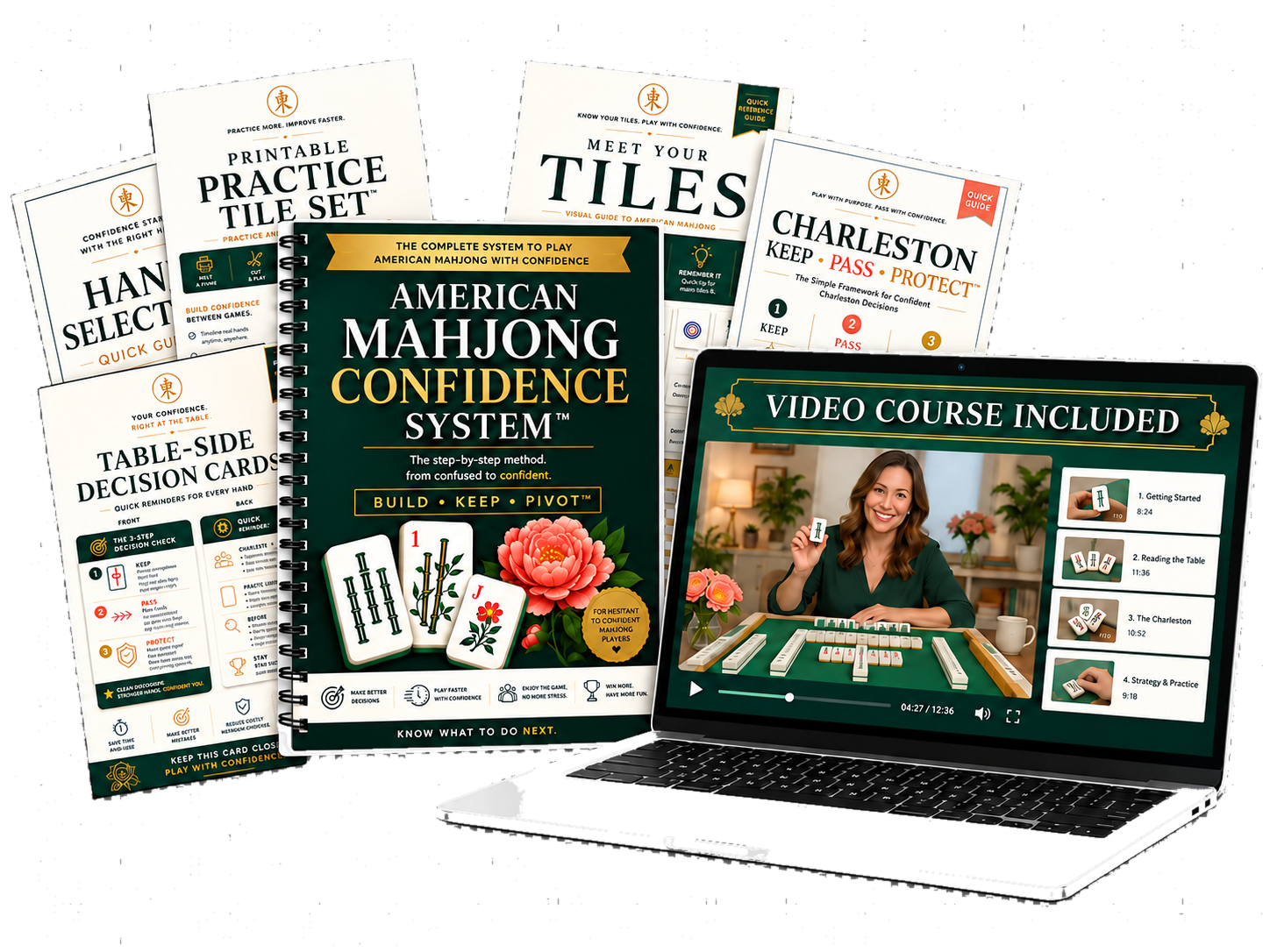
NOW INCLUDED WITH YOUR SYSTEM
Some decisions are easier to understand when you can see the thinking unfold. The included video course walks through the complete Confidence System™ in short, practical lessons you can watch at your own pace.
Video Course Included · 18 Guided Lessons · Instant Access
DOES THIS SOUND FAMILIAR?
You pick up your tiles and look at the NMJL card.
There are several hands that might work — but you’re not sure which one makes the most sense.
Then the Charleston starts.
Everyone else seems ready to pass. You’re still deciding what you can safely let go.
A few turns later, the hand you chose isn’t coming together the way you expected.
Now the questions start piling up:
Should I stay with this hand?
Should I change direction?
Which tile should I discard?
Am I missing something everyone else can see?
And while you’re trying to figure it out, there’s one thought sitting quietly in the back of your mind:
“I don’t want to slow everyone down.”
If this sounds like your game night, the problem probably isn’t that you need to learn more rules.
The problem is that nobody ever gave you a simple process for turning the tiles in front of you into a confident next decision.THE REAL REASON YOU STILL HESITATE
You can know what a Pung is.
You can understand how the Charleston works.
You can recognize Jokers, Winds and Flowers.
You can have the current NMJL card sitting right in front of you.
“Okay... what should I do now?”
That's because knowing the rules and making decisions are two different skills.
The rules tell you how American Mahjong works. But they don't automatically tell you which hand makes the most sense for the tiles in front of you, what you should protect during the Charleston, which tile to discard, or when it's time to change direction.
A SIMPLER WAY TO THINK AT THE TABLE
BUILD · KEEP · PIVOT™
Look at the tiles you actually have and narrow your options to a few realistic directions — instead of scanning the entire NMJL card and hoping something jumps out.
Less overwhelm. A clearer starting direction.Identify which tiles protect your strongest options and which ones you can let go — especially when the Charleston puts you under pressure to decide quickly.
Stop passing and discarding on instinct alone.Notice when your original plan is getting stronger — and when the tiles, discards and exposures are telling you it's time to reconsider.
Know when to stay with your hand — and when to let it go.Starting tiles. Charleston. New draws. Discards. A hand that suddenly stops working.
The situation changes. The three questions stay the same.You don't need the perfect decision every time.
You need a process you can trust every time you have to decide.
REAL PLAYERS. REAL PROGRESS.
I used to spend forever moving between my tiles and the card. The narrowing process gave me a much clearer place to start. I still check the card, of course, but I no longer feel like I have to consider every possible hand at once.
Keep · Pass · Protect changed the way I think about the Charleston. Before, I was mostly passing tiles that looked useless. Now I have a reason for what I keep and what I let go.
I already knew the basic rules before I bought this. What I was missing was how to turn those rules into an actual decision. This feels much more practical than starting another beginner course.
SEE THE SYSTEM IN ACTION
Imagine you’re in the first pass of the Charleston.
You have a pair worth protecting, a Joker, and several isolated tiles that don’t clearly support a direction yet.
You need to pass three tiles.
Instead of asking, “Which three should I get rid of?” — run the system.You don’t have enough information to force one specific hand yet.
So your job isn’t to “pick the winner.”
Your job is to preserve the strongest realistic possibilities.The pair already gives you structure.
The Joker gives you flexibility.
Those tiles stay.Not yet. This is only the first pass.
Stay flexible, make the best pass you can, and let the next tiles give you more information.You didn’t memorize another rule.
You didn’t need someone at the table to tell you what to pass.
And you didn’t need to know exactly how the entire hand would unfold.
And the Charleston is only one place you’ll use it.
Starting tiles. Hand selection. New draws. Discards. Changing direction. Late-game decisions.
BUILD · KEEP · PIVOT™ gives you a process to come back to throughout the game.INTRODUCING
American Mahjong Confidence System™
The American Mahjong Confidence System™ was created for the moment after you've learned the basics — when you understand how the game works, but still find yourself hesitating over what to actually do.
Instead of giving you more rules to memorize, it gives you a practical process to follow.Know what to look for before you start chasing a hand.
Narrow the possibilities instead of getting lost in all the options.
Have a reason for what you keep, pass and protect.
Know what deserves to stay — and what can go.
Recognize when it's time to pivot instead of stubbornly chasing a dying hand.
Use a repeatable process instead of making another guess.
Practice the exact decisions that normally slow you down.
It's the system you use after you know the basics — to turn what you've already learned into faster, clearer, more confident decisions at the table.
So instead of sitting down at your next game night hoping you'll know what to do...
you sit down with a process.INSIDE THE CONFIDENCE SYSTEM
The American Mahjong Confidence System™ follows the same decisions you face in a real game — in the same order you face them.
So you're not learning disconnected tips.Learn what to notice before opening the NMJL card — pairs, suit concentration, flexibility, Jokers and other signals that can point you toward realistic options.
Start with your tiles. Not with a guess.Use a narrowing process to reduce dozens of possibilities to two or three realistic candidates you can actually track.
Fewer possibilities. Less overwhelm. Clearer direction.Use the Keep · Pass · Protect framework to give every Charleston decision a reason — while keeping enough flexibility to adapt as new tiles come back.
No more choosing three tiles just because they “look useless.”Learn the signals that suggest your direction is getting stronger, the warning signs that it's dying, and how to look for a better path without starting from zero.
Follow the evidence — not your attachment to your first idea.Use a four-question discard process that considers your current plan, what opponents are showing, and how far the game has progressed.
Turn “I guess I'll throw this one” into a reasoned decision.Understand the Joker rules that matter most for real decisions — and avoid the common mistakes that can derail an otherwise promising hand.
Learn to use exposures, discards and changes in play as clues — without trying to predict every opponent's exact hand.
You don't need to read minds. You need to notice useful patterns.Use short timed drills for starting-hand analysis, hand selection, Charleston, discards and pivot recognition.
Accuracy first. Speed follows with repetition.Follow a structured 15-minute routine to practice hand recognition, decision-making and real-game scenarios between Mahjong nights.
Your Mahjong group doesn't have to be your only chance to improve.Use a chronological playbook that reminds you what to think about before the Charleston, during the hand, when things change, and as the game moves toward the end.
One process. From your first look at the tiles to your final decision.It's to help you sit down, look at the game in front of you, and have a clearer idea of what to do next — without constantly waiting for someone else to tell you.
That's what playing with confidence actually looks like.GET THE CONFIDENCE SYSTEM — $39 Instant Digital Access · Printable Practice Tools · Table-Side Decision Card Included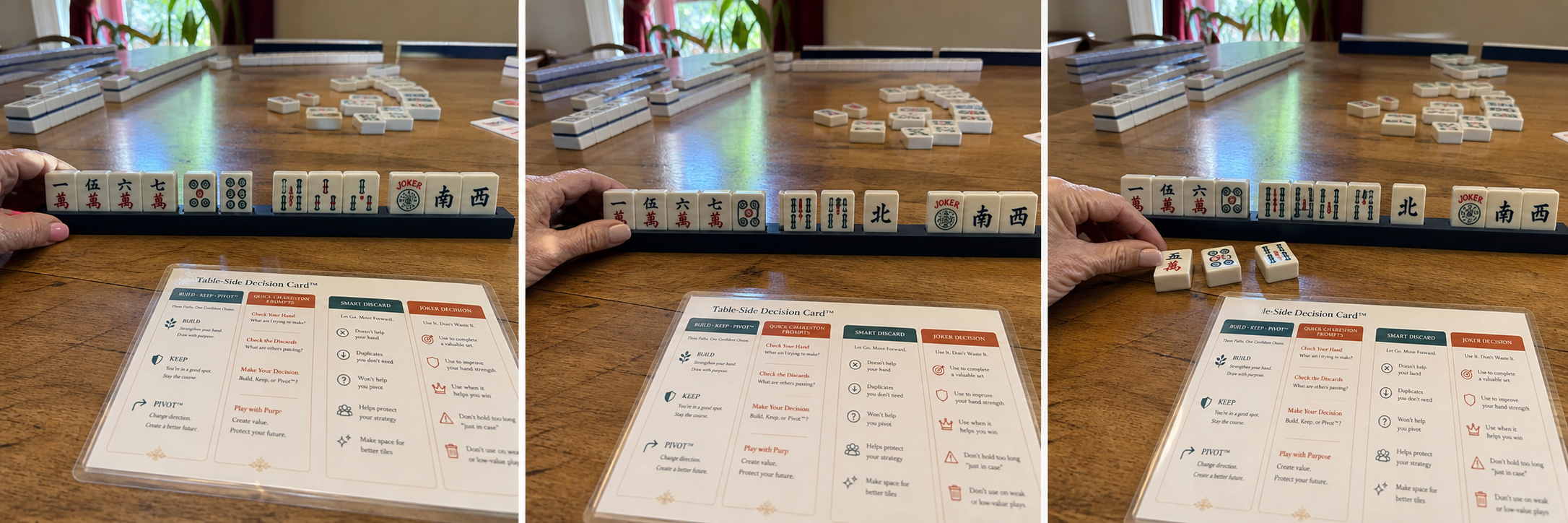
REAL PLAYERS. REAL GAME NIGHTS. REAL PROGRESS.
See how players are using the American Mahjong Confidence System™ to practice between games, make clearer decisions at the table, and feel more confident when it's their turn to choose.
Different players struggle with different decisions. Here's what changed for them.The Charleston and hand-selection sections have been extremely useful. I personally learn well from demonstrations, so a few short videos would make it even better for me. The printable tools are excellent.
I'm still not the fastest player in my group, but I don't feel like everyone is waiting for me on every turn anymore. Having the same questions to come back to has made a real difference.
I bought this very early and realized I needed to understand the basic flow of American Mahjong first. After a few lessons I came back to it and it made much more sense. I wouldn't use it as a first-ever introduction.
I already knew the basic rules before I bought this. What I was missing was how to turn those rules into an actual decision. This feels much more practical than starting another beginner course.
I expected to read it once and immediately feel faster. It really clicked when I started doing the practice scenarios instead of just reading. I would recommend actually using the exercises.
The table-side card is probably what I use most. I printed it and keep it with my Mahjong things. It's nice to have the key questions in front of me without reopening the full guide.
I only play with my group once a week, so the solo practice section was a big reason I wanted this. Building random hands and working through what I would keep or pass has been surprisingly helpful.
The material is clear and the exercises are thoughtful. I simply learn better when an instructor is sitting with me, so I use this more as a reference between lessons than as my main way of learning.
I've read a lot of Mahjong advice that disappears from my head once I'm actually playing. BUILD · KEEP · PIVOT is simple enough that I can remember it when I need it.
The organization is very good and the quick-reference material is useful. Some sections were more basic than I personally needed, but I still found several ideas that changed how I approach my hand.
My favorite part was having to make a decision before reading the explanation. The scenarios made me notice several habits I didn't realize I had.
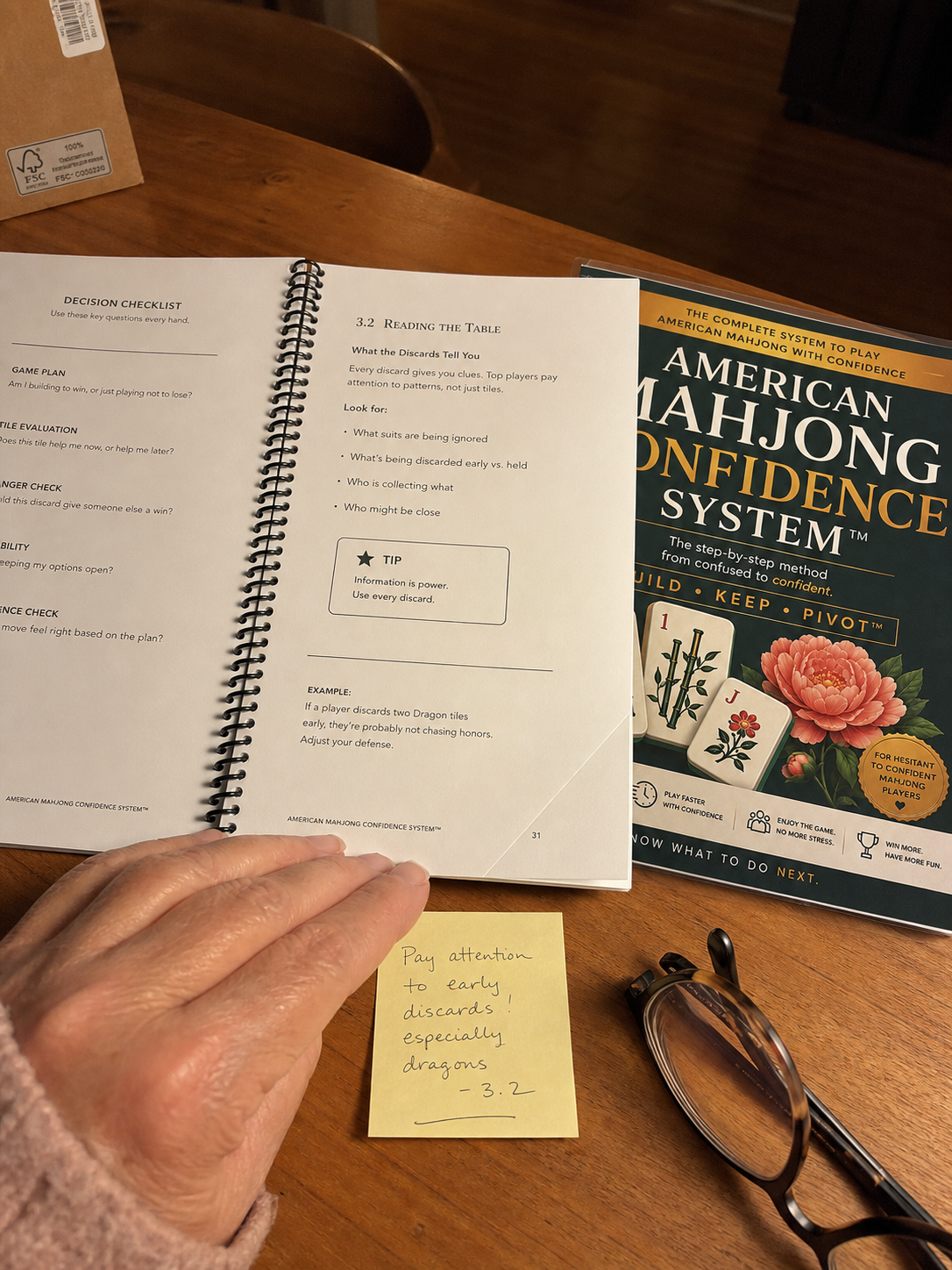
I was terrible about getting attached to the first hand I picked. The pivot section helped me understand what I should actually be watching for before deciding to change direction.
I don't use every printable, but the Decision Card, Charleston framework and pivot section are worth it for me. Those are the pages I keep coming back to.
I expected another digital guide with a lot of reading. It's much more hands-on than that. I printed several of the tools and have been using them while I practice.
The NMJL card used to overwhelm me because I wanted to look at everything. Starting with my tiles and narrowing the possibilities first feels much more manageable.
I noticed during my last game that I wasn't asking the woman next to me what she thought I should do nearly as often. That alone made me feel much more comfortable.
The Smart Discard questions gave me a way to slow my thinking down without slowing the whole table down. I'm not just throwing the tile that looks least useful anymore.
I didn't realize how much second-guessing was taking the fun out of playing. I'm not suddenly perfect, but I feel much calmer about making my own decisions.
The material follows the order of a real game, which made it easy for me to understand where each idea fits. It doesn't feel like a pile of unrelated Mahjong tips.
I took beginner lessons and understood the mechanics, but I still felt lost once people stopped helping me. This was the bridge I needed between knowing the rules and actually playing independently.
What I appreciated most is that it doesn't pretend you can control every hand. It gives you a process for making a reasonable decision with what you actually have.
I printed the main sections and put the quick references in my Mahjong binder. I like digital products, but I really appreciate having something I can physically use.
You may not control which tiles you draw — but with a clear process, you can stop feeling like every decision is a guess.
That's the kind of progress the Confidence System™ was built for.GET THE CONFIDENCE SYSTEM — $39 Instant Digital Access · Printable Practice Tools · Table-Side Decision Card IncludedEVERYTHING YOU NEED TO PUT THE SYSTEM INTO PRACTICE
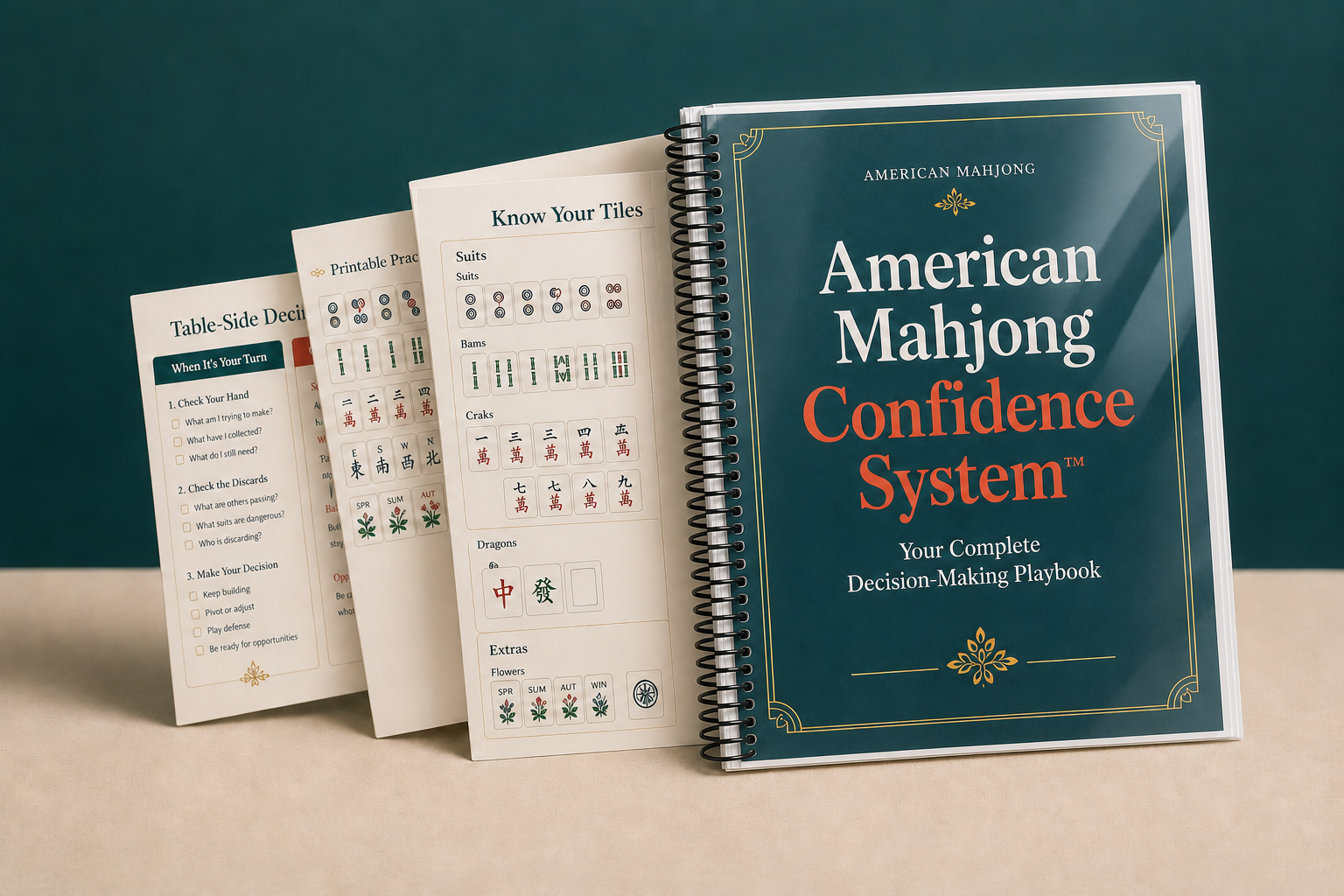
American Mahjong Confidence System™
The complete step-by-step system for turning the rules you already know into clearer decisions throughout a real American Mahjong game.
BONUS #1 — Table-Side Decision Card™
Print it, keep it close, and quickly refresh the questions behind BUILD · KEEP · PIVOT™, Smart Discard, Charleston and Joker decisions.
Because you shouldn't need to reopen a 75-page guide in the middle of game night.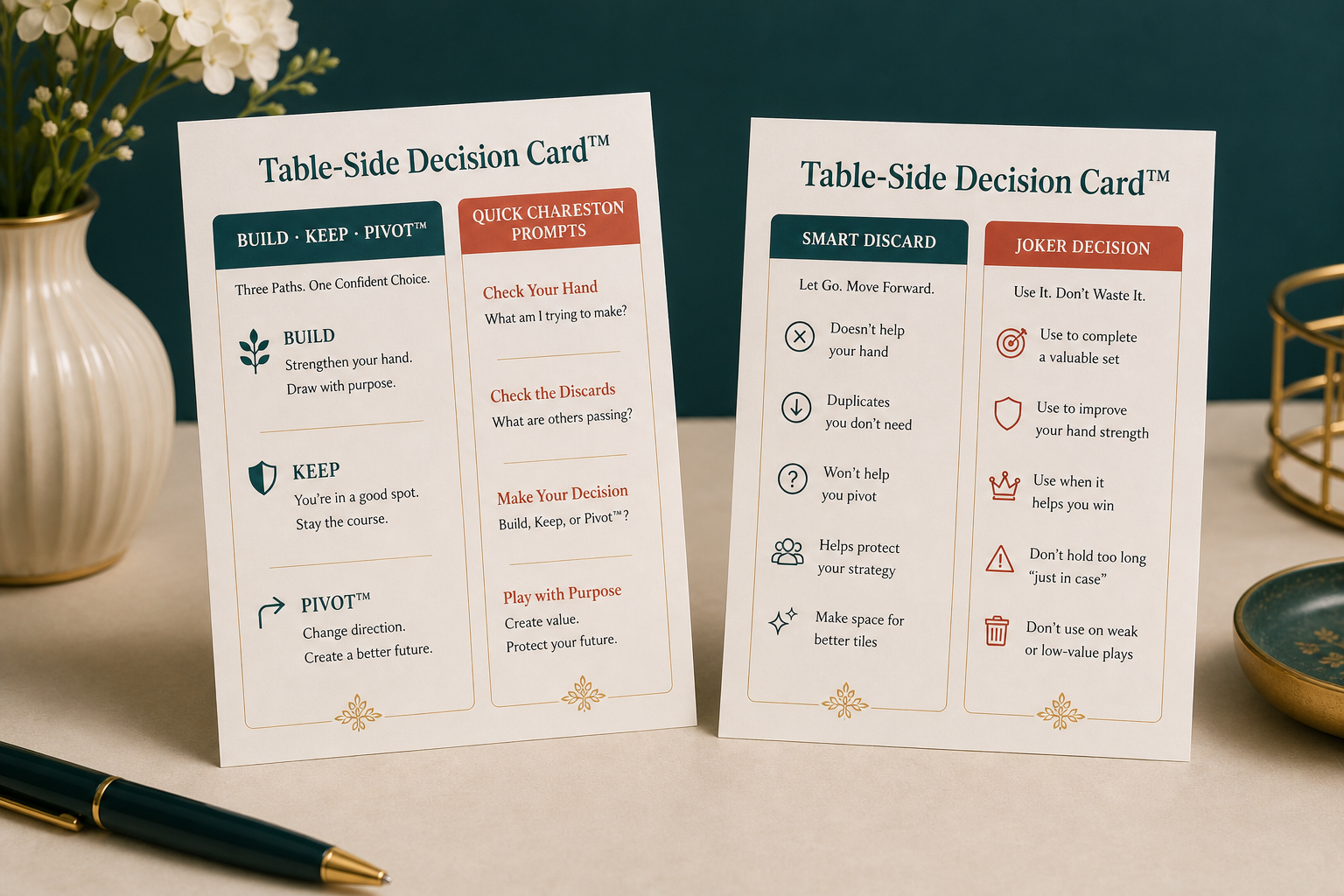
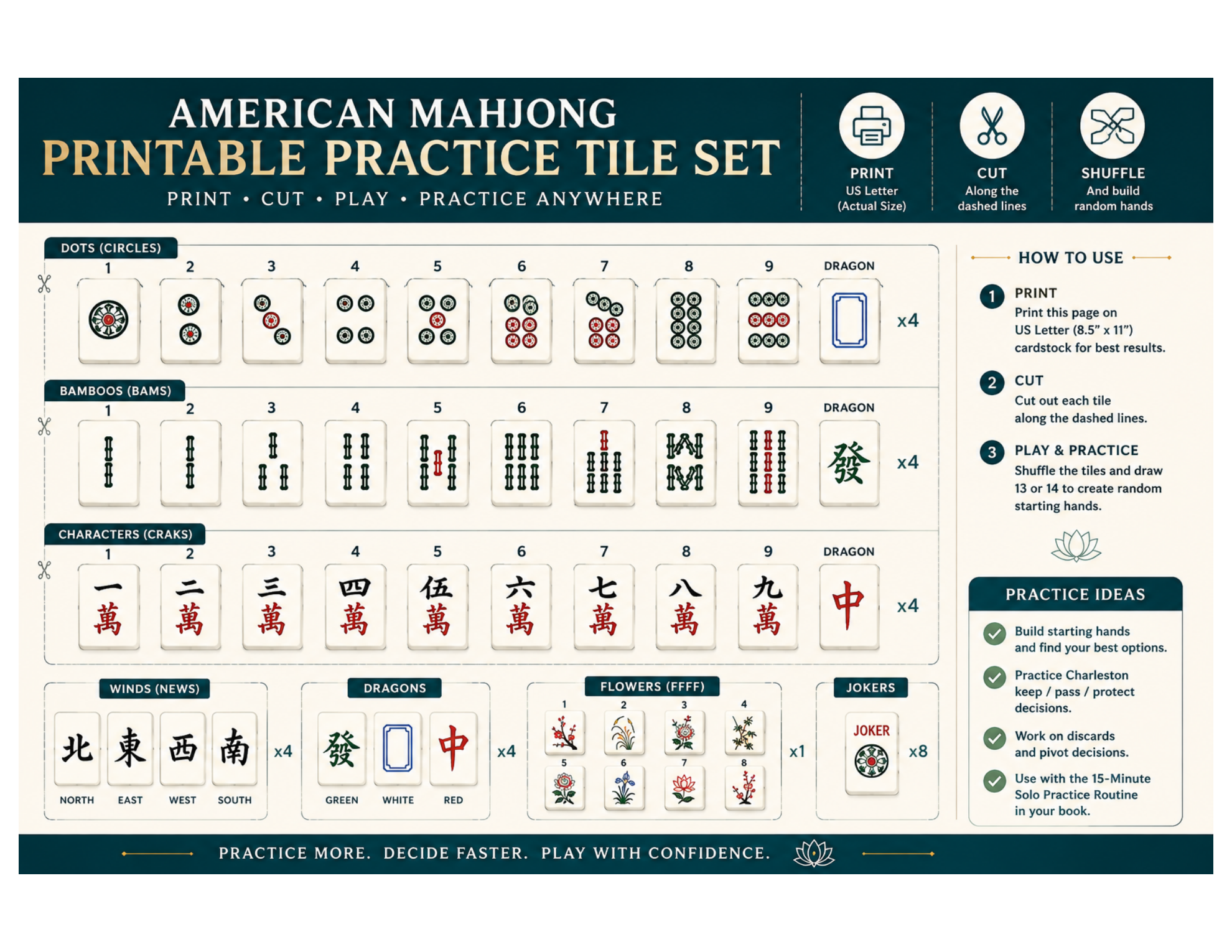
BONUS #2 — Printable Practice Tile Set
Print and use the practice tiles to create random starting hands and train hand selection, Charleston decisions, discards and pivot recognition between game nights.
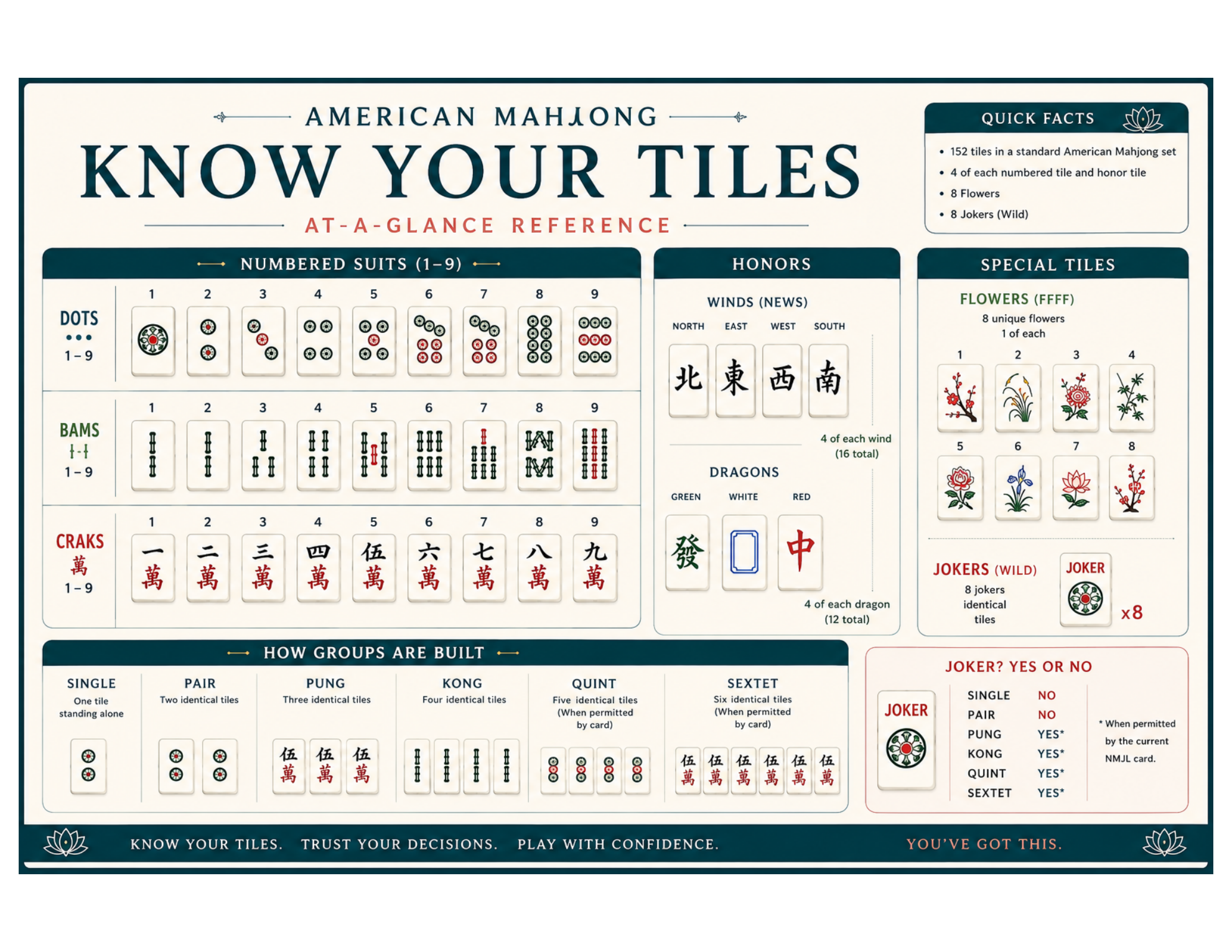
Your Mahjong group doesn't have to be available for you to practice.BONUS #3 — Know Your Tiles — At-a-Glance
Keep Dots, Bams, Craks, Winds, Dragons, Flowers, Jokers and common tile groups organized in one easy-to-scan reference.
One page. One glance. No unnecessary searching.YOUR COMPLETE CONFIDENCE TOOLKIT INCLUDES:
Everything is included today for one simple payment of:
Learn the process.
Practice the decisions.
Take the system with you to the table.
TRY IT FOR YOURSELF
Download the system. Read through the method. Print the tools. Work through the practice scenarios. Use the Decision Card. And, if you can, take what you've learned into a real game.
Give yourself enough time to actually use the system — not just skim it.
If you go through the American Mahjong Confidence System™ and decide it isn't right for you, simply contact us within 30 days of your purchase for a refund, subject to our refund terms.
STILL HAVE QUESTIONS?
Yes — that's exactly who the Confidence System™ was designed for.
Traditional lessons can teach you how American Mahjong works. The Confidence System™ focuses on what often comes next: choosing a realistic direction, navigating the Charleston, deciding what to discard, knowing when to pivot, and becoming less dependent on other players when it's your turn to decide.
If you understand the basics but still hesitate at the table, you're in the right place.
Not primarily.
The Confidence System™ is designed for beginner and early-intermediate players who already understand the basic flow of American Mahjong.
If you're still learning what the tiles are or how the game fundamentally works, start with the basics first. If you know the basics but still find yourself thinking “What do I do now?”, this system was built for that next step.
Yes. Your purchase now includes an 18-lesson video course in English, together with the complete printable Confidence System™.
The short, practical lessons walk you through the decision process step by step, while the playbook, practice scenarios, training tools and Table-Side Decision Card™ help you apply it before and during game night.
Yes. The Confidence System™ is designed to work alongside the current NMJL card, not replace it.
The card remains your reference for the specific hands, combinations, point values and applicable rules for the year you're playing.
The Confidence System™ teaches you the decision process for working with the tiles and options in front of you.
The specific hands on the card change. The way you make decisions doesn't have to.
BUILD · KEEP · PIVOT™ is designed as a decision framework rather than a list of hands to memorize.
You'll still assess your starting tiles, narrow your options, protect useful tiles, react to new information and reconsider your direction when the evidence changes.
No — and any product that promises that shouldn't be trusted.
You can't control which tiles you draw or how a particular hand unfolds.
What you can improve is the process behind your decisions: what you pursue, what you protect, what you discard and when you reconsider your plan.
Better decisions don't guarantee every outcome. They give you a better process.
You can practice many of the decisions that normally slow you down without playing a full four-player game.
The Confidence System™ includes a 15-Minute Solo Practice routine, decision scenarios and printable practice tools designed to help you rehearse starting-hand analysis, hand selection, Charleston decisions, discards and pivot recognition between game nights.
You'll receive instant digital access to the complete American Mahjong Confidence System™ and the included printable bonus tools.
You can read the materials digitally, print the tools you want to use, and begin working through the system right away.
Get the complete American Mahjong Confidence System™ and start putting BUILD · KEEP · PIVOT™ into practice today.
GET INSTANT ACCESS — $39 One-Time Payment · Instant Digital Access · 30-Day Money-Back GuaranteeYOUR NEXT MAHJONG NIGHT CAN FEEL DIFFERENT
Imagine sitting down at your next game night.
You pick up your tiles.
Instead of immediately wondering which hand you're supposed to choose, you know what to look for.
The Charleston begins.
Instead of passing three tiles just because they look useless, you have a reason for what you keep, what you pass and what you protect.
The hand starts to change.
Instead of stubbornly holding onto your first idea, you know what signals should make you reconsider.
It's your turn to discard.
Instead of making another guess, you have a process to run.
That's not confidence.
Confidence is knowing why you're making the decision you're making — without constantly looking around the table hoping someone else will tell you what to do.
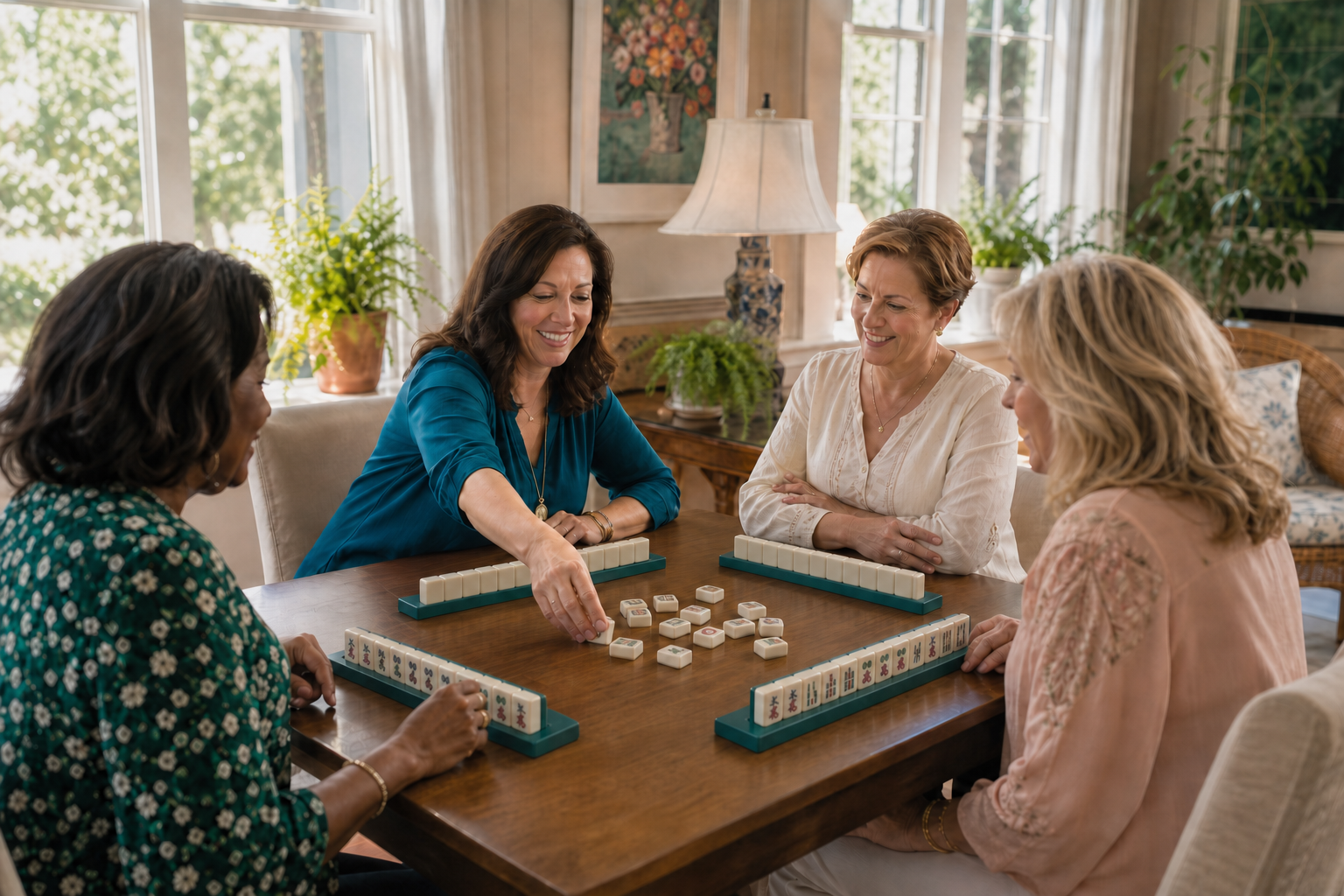
Know what to look for.
Know what to ask yourself.
Know what to do next.

